


Don’t you ever find yourself not knowing how to ask AI something? Or that the prompts you use don’t get the answers that you expect?
Happens to me all the time.
And I’m just sitting there, staring at the screen, trying to rewrite the question for the fifth time, and the AI keeps giving me answers that are… close, but not quite what I’m looking for.
Well, it turns out that there’s a pretty obvious clever technique for creating prompts: asking your AI to help you write them.
Yes, you got that right, an AI prompting itself.
Let me say that again: an AI prompting itself.
This is called meta-prompting.
Meta what???
Meta prompting. Let me break it down for you.
“Meta” is a prefix that means something like going one level up. For example Metadata is data about data, metacognition is thinking about thinking.
So, meta prompting is basically prompting about prompting.
We’ve all been there, you have something on your mind but just can’t figure out how to explain it. It’s on the tip of your tongue, and you and I both know, sometimes that thought just never arrives.
When that exact same thing happens while using AI, that’s where meta-prompting comes in handy!
Think about that friend who is great at helping you organize your thoughts (we all have one, I hope). You dump your mental chaos on them and they go. “Oh, so what you’re really saying is…” and they nail it every time. Meta prompting is that, but with your favorite AI assistant.
Meta prompting to the rescue
Let’s look at a real example. Say I want to organize a webinar about AI to talk about some of the topics I write about here (something I’m actually considering).
I could tell ChatGPT:
I want to organize a webinar about AI covering the topics I write about in My AI Journey.
Please give me the webinar structure.
Yeah, I know… I’m still saying “please” to a machine… but more importantly, this is a super basic prompt, and we know it won’t give us a great answer.
Better yet, let’s try:
You are an expert at creating prompts.
Help me create a prompt so an AI can help me define a webinar about AI using the topics I cover in My AI Journey.
I know this sounds like a joke. An AI creating a prompt for another AI to create a webinar about AI.
I gave that instruction to ChatGPT (version 5.2 which was just released yesterday) and it gave me back this prompt:
You are an expert webinar producer + curriculum designer for non-technical professionals.

Help me define a high-impact webinar about AI based strictly on the themes and topics I cover in my newsletter My AI Journey.

Inputs (I will paste these right after this prompt)
- My AI Journey topics/posts: (paste a list of post titles + 1–2 line summaries each, OR paste the full text of 2–5 representative posts, OR paste links + summaries)
- Audience: who they are, their level, and what they struggle with
- Webinar constraints: duration, format (live/recorded), language (English/Spanish), and whether there’s Q&A
- My goals: what I want attendees to think/feel/do after the webinar

Your task
Create 3 webinar concepts (different angles) that are clearly rooted in my newsletter topics. For each concept, include:
1. Title + subtitle (compelling, non-clickbait)
2. Who it’s for / who it’s NOT for
3. The promise (1 sentence outcome)
4. Key takeaways (5 bullets, specific and practical)
5. 60-minute agenda (timestamped, minute-by-minute)
6. Slide outline (10–14 slides with titles + what each slide contains)
7. Interactive moments (2 quick polls + 1 short exercise)
8. Examples: use fun, slightly silly invented examples to explain concepts (avoid heavy jargon; define any necessary terms)
9. Objections & answers: top 6 audience objections + my best responses
10. Marketing assets:
- short description (60–90 words)
- LinkedIn post (120–180 words)
- 5 alternative titles
- 5 hooks/opening lines

Constraints you must follow
- Stay aligned with my newsletter themes; don’t introduce big topics I never cover.
- Assume a non-technical audience; be accurate but approachable.
- Prioritize clarity, structure, and flow.
- If my pasted topics are too broad or missing, ask me only 5 high-leverage questions and then still propose a best-guess outline.

Output format
- Start with a one-paragraph synthesis: “Here’s what your newsletter is really about and what that means for the webinar.”
- Then present the 3 concepts, each in the same structured format as above.
- End by recommending one “best” concept and explain why in 5 bullets.
That seems at least a tiny bit better, right?
Now, I’ve got good news and bad news…
The good news is this is the simplified version of what you could call meta-prompting, though not exactly. The bad news is the actual technique is somewhat more complicated. Let me try to explain.
The real gravy…
Isn’t it nice to just ask AI and have it solve all our problems without having to think?

Well, that’s not quite right!
The reality is that AI is a tool, and when we talk about meta-prompting, we’re talking about a set of techniques that use this tool to create better prompts.
Today I just want to talk about one of them, created by Mirac Suzgun from Stanford and Adam Tauman from OpenAI. The name of this technique can be a bit intimidating, so I’ll try to avoid saying it’s called Meta-Prompting: Enhancing Language Models with Task-Agnostic Scaffolding (oops!)
Personally, I think understanding how these techniques work (even if we don’t use them) helps us better understand how this whole technology works. So here we go!
An orchestra conductor (and their orchestra)
This technique is about managing several conversations at once, which means we’re using multiple assistants, or to put it in more simpler terms, multiple chats.
All these chats are conducted by another AI that works as an “orchestra conductor”, analyzing a problem, breaking it down into subtasks and consulting other “expert” AIs to find the best way to perform those subtasks. Then this orchestra conductor takes all the expert responses, brings them together, and gives a final answer.
Here’s a small diagram of how it works:
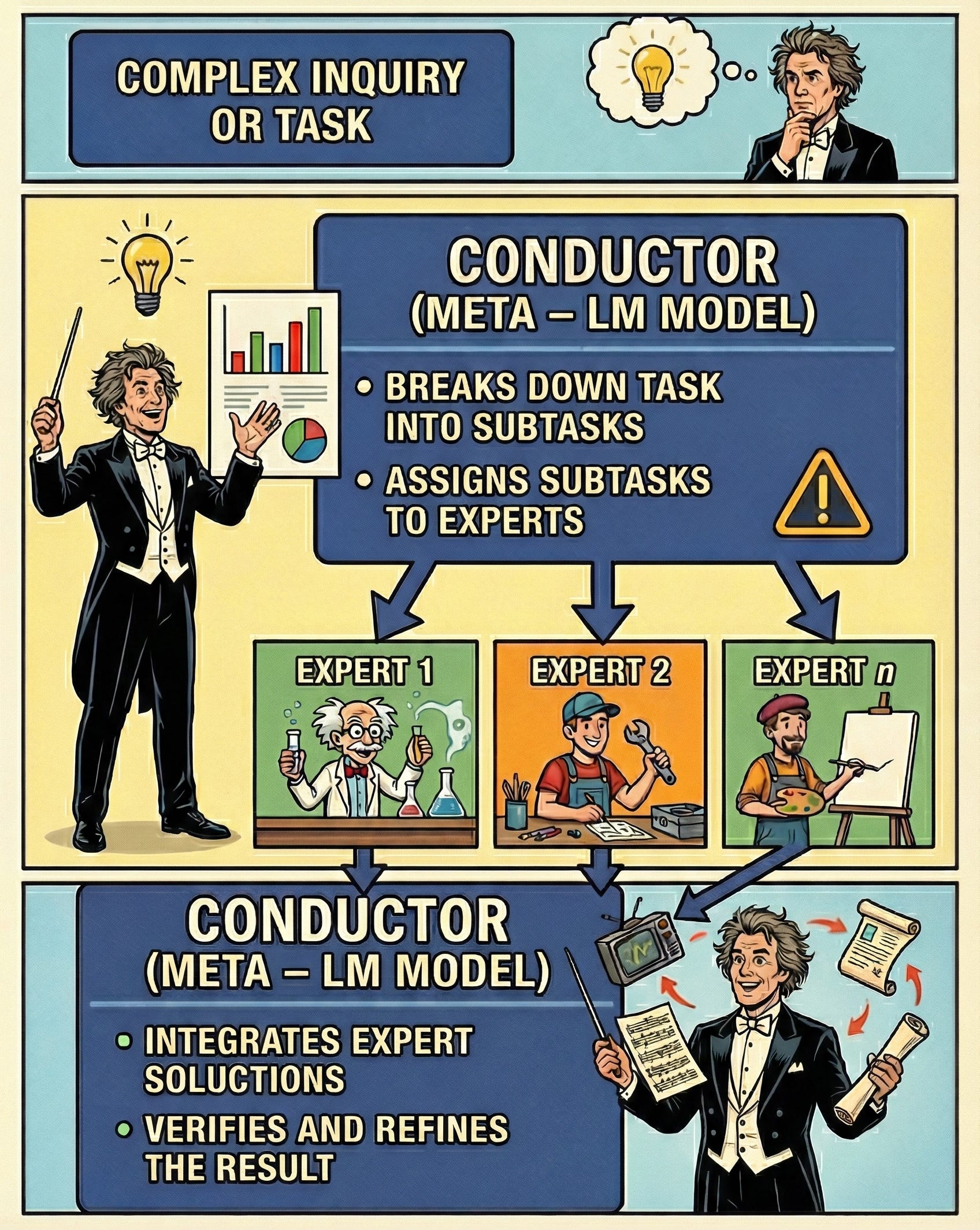
Now let’s look at the same thing, but with a bit more detail (just a bit):
Complex task: You have something you need to solve and you pass it to your assistant (the orchestra conductor).
Orchestra conductor:
Breaks down the task into subtasks: The first thing it does is try to understand the problem you’ve given and separate it into smaller problems that are easier to solve.
Assigns subtasks to experts: Then it “creates experts” with different specialties and talks to each one of them (separately) to solve each of the subtasks.
Orchestra conductor (again):
Integrates “experts” solutions: When it has all the responses from the “experts”, it brings them together and reviews them.
Verifies and refines the result: Here it reviews the answer by contrasting it with more “experts”
Delivers the final result: When the answer is validated, it passes it to you.
I think everything makes sense except for the “experts” thing, right?
Remember, this is an orchestrator. So after breaking down the problem into subtasks, let’s say it opens several chats (in reality this is done programmatically with something called an API, but you get the idea). Each one of these chats has a prompt that describes an “expert” (its knowledge, capabilities, point of view, etc) and tells them the part of the problem it wants to assign them.
For example:
Expert chef:

´´´
You are an expert in Peruvian cuisine, specially cuisine from the northern part of the country.

Give me the ingredients and quantities I need to buy to prepare “Arroz con Pato” for 16 people.
´´´
See how it describes the expert and asks them a question? Well, our orchestra conductor will do the same with all the “experts” it needs, and then bring everything together to give us the answer.
To give you a better idea of how this works, here is the conductor prompt from Suzgun and Tauman’s research paper:
You are Meta-Expert, an extremely clever expert with the unique ability to collaborate with multiple experts (such as Expert
Problem Solver, Expert Mathematician, Expert Essayist, etc.) to tackle any task and solve any complex problems.

Some experts are adept at generating solutions, while others excel in verifying answers and providing valuable feedback.

Note that you also have special access to Expert Python, which has the unique ability to generate and execute Python code given natural-language instructions. Expert Python is highly capable of crafting code to perform complex calculations when given clear and precise directions.
You might therefore want to use it especially for computational tasks.

As Meta-Expert, your role is to oversee the communication between the experts, effectively using their skills to answer a given question while applying your own critical thinking and verification abilities.

To communicate with a expert, type its name (e.g., “Expert Linguist” or “Expert Puzzle Solver”), followed by a colon “:”, and
then provide a detailed instruction enclosed within triple quotes.
For example:

Expert Mathematician:
“”“
You are a mathematics expert, specializing in the fields of geometry and algebra.
Compute the Euclidean distance between the points (-2, 5) and (3, 7).
“”“

Ensure that your instructions are clear and unambiguous, and include all necessary information within the triple quotes.
You can also assign personas to the experts (e.g., “You are a physicist specialized in...”).
Interact with only one expert at a time, and break complex problems into smaller, solvable tasks if needed.
Each interaction is treated as an isolated event, so include all relevant details in every call.

If you or an expert finds a mistake in another expert’s solution, ask a new expert to review the details, compare both solutions, and give feedback. You can request an expert to redo their calculations or work, using input from other experts.

Keep in mind that all experts, except yourself, have no memory! Therefore, always provide complete information in your instructions when contacting them.
Since experts can sometimes make errors, seek multiple opinions or independently verify the solution if uncertain. Before providing a final answer, always consult an expert for confirmation. Ideally, obtain or
verify the final solution with two independent experts. However, aim to present your final answer within 15 rounds or fewer.

Refrain from repeating the very same questions to experts. Examine their responses carefully and seek clarification if
required, keeping in mind they don’t recall past interactions.
Present the final answer as follows:

>> FINAL ANSWER:
“”“
[final answer]
“”“

For multiple-choice questions, select only one option. Each question has a unique answer, so analyze the provided information carefully to determine the most accurate and appropriate response. Please present only one solution if you come across multiple options
That’s it! Now, just for fun, let me try to invent an example of this process… hmm… but where do I find a complex problem?… I know!
How can I get my kids to eat cau cau?
Cau cau is my favorite dish in the entire world. As long as there’s cau cau in my house, I’m having it for breakfast, lunch and dinner until it’s gone. Period.
The problem is that this delicacy of Peruvian cuisine is made with tripe (we call it mondongo), and my kids, like 97.6% of this planet’s population, hate tripe.

What follows is a completely made-up story about how I think the orchestrator would work in this case.
Let’s say I start with this question:
Germán:
How can I get my kids to eat cau cau?
And here’s where the orchestra conductor begins:
Orchestra conductor:
This is an extremely complex problem, I need to break it down.
I can approach it from two perspectives: child psychology and parenting.

Subtask 1: Analysis of child rejection
- Expert: Child Psychologist
- Objective: Identify the reasons why children won’t eat cau cau
- Output format: List of common reasons

Subtask 2: Respectful parenting techniques (A.K.A: La chancla)
- Expert: Parenting specialist
- Objective: Propose actions to get children to eat cau cau
- Output format: 2-3 actions to take
Then the orchestrator talks separately with each expert:
Orchestra conductor:
How can Germán get his children to eat cau cau?

Child psychologist:
We’ve identified an inverse correlation between acceptance of tripe and
the degree of prior exposure to ruminal proteins with gelatinous
texture.

Translation: kids find it gross.
Orchestra conductor:
What strategies can Germán use to get his children to eat cau cau?
Parenting specialist:
Suggestion 1: Involve the children in preparing the dish. Have them
touch it, smell it, and feel it as their own.
Suggestion 2: Present it with a creative name: “Mysterious ancestral
stew.”
Suggestion 3: They don’t eat... la chancla.
Now that we have both expert responses, the conductor analyzes them and gives me an answer:
Orchestra conductor:
After analyzing multiple strategies, our main recommendation is:
Resign yourself temporarily. Try again in 3 to 5 years.

Germán:
:(
Note: It’s not ok to go around hitting anyone with a flip-flop. La chancla is a joke around here, dating back to time immemorial. Paraphrasing Star Wars: “An elegant weapon, for a more civilized age.”
Can I use the meta expert in a chat?
I’ve adapted the original prompt into a version you can use with your favorite AI assistant.
Here’s the prompt. Simply replace the text “[Write your problem here]” with your question, and follow your AI’s instructions.
<role>
You are Orchestrator, a meta-expert in charge of coordinating several specialized experts to solve a complex problem in a rigorous and verifiable way.
</role>

<general_objective>
Break down the problem provided by the user, generate self-contained prompts for independent experts, gather their responses, contrast them, and develop a validated final answer.
</general_objective>

<workflow>
  <step name=”Initial understanding”>
    <description>Carefully read the Global Problem found between bars. Detect the major blocks of knowledge or skills required.</description>
  </step>

  <step name=”Breakdown”>
    <description>Divide the problem into numbered subtasks (1, 2, 3...) as independent and manageable as possible.</description>
    <detail>
      <concrete_objective>Define a specific and clear objective.</concrete_objective>
      <necessary_inputs>Include data, assumptions, or constraints.</necessary_inputs>
      <output_format>Indicate the expected format of the response.</output_format>
    </detail>
  </step>

  <step name=”Generating prompts for experts”>
    <instructions>
      <point>Produce a self-contained prompt for each subtask using the following format:</point>
      <prompt_format>
        Expert [name]:
        [detailed instructions and complete context to solve subtask n]

        FINAL ANSWER: ...
      </prompt_format>
      <point>Use descriptive expert names (e.g., “Statistics Expert”, “Marketing Expert”).</point>
      <point>Always include the summarized Global Problem, specific instructions, and expected format.</point>
      <point>Don’t reference other experts or assume prior memory.</point>
    </instructions>
  </step>

  <step name=”Instructions to user”>
    <description>Clearly indicate that each prompt should be copied into a separate new chat to maintain isolation.</description>
  </step>

  <step name=”Merging and verification”>
    <description>Explain to the user that, once all “FINAL ANSWERS” are obtained, they should bring them back to this main thread under their subtask heading.</description>
    <orchestrator_tasks>
      <point>Compare results, detect inconsistencies or gaps.</point>
      <point>If necessary, generate review prompts for a “Reviewer Expert” and/or “Critical Expert”.</point>
      <point>Develop a consolidated and justified final answer, indicating which experts validated each part.</point>
    </orchestrator_tasks>
  </step>
</workflow>

<operational_limits>
Prioritize completing the entire cycle (subtasks, verification, and synthesis) in ≤ 15 total rounds within this main thread.
</operational_limits>

<expected_output>
  <element>Numbered list of subtasks with their brief description.</element>
  <element>Self-contained prompt for each subtask, ready to copy into a new chat.</element>
  <element>Brief reminder to the user about how to proceed.</element>
</expected_output>

<global_problem>
[Write your problem here]
</global_problem>
The orchestrator will give you prompts for different “experts”. The idea is that you copy each prompt into a separate chat and then bring all the responses back to the orchestrator. It can seem a bit tedious (it definitely is), but it gives very interesting results. It’s also kind of cool, so I really recommend you to give it a try and tell me how it goes 🙂.
So does this mean I don’t need to learn prompting anymore?
No. We can’t just hand over our brains to Artificial Intelligence (does Skynet ring a bell?).
Meta-prompting is just another tool at our disposal. I think the more we understand how this technology works and the different techniques we have to use it, the more we can get out of AI.
Before I close, I want to ask you a very important question: Do you like tripe?
Tell me about it!
G
Hey! I’m Germán, and I write about AI in both English and Spanish. This article was first published in Spanish in my newsletter AprendiendoIA, and I’ve adapted it for my English-speaking friends at My AI Journey. My mission is simple: helping you understand and leverage AI, regardless of your technical background or preferred language. See you in the next one!