



I’m going to assume you’ve seen Karate Kid (1984). I’ve seen it about 758 times. In the movie there are two karate schools with philosophies that couldn’t be more different.
There’s Cobra Kai, where the sensei screams “Strike first, strike hard, no mercy” while teaching you bone-breaking techniques from day one.
On the other end there’s Miyagi-Do, where an old man has you doing household chores like waxing (and buffing) his classic car collection, painting fences, or sanding the floor before teaching you a single move.
The thing is, I started thinking about it, and I believe something very similar is happening in the world of AI.
Let me tell you about it...
Note: Karate Kid is one of my favorite movies. Parts II and III are also good, Part IV is terrible. Also, the Cobra Kai series (Netflix) is an amazing show.
The two schools
As I was saying at the beginning of this post, in the world of generative AI I see two types of messages almost every day, and they couldn’t be more different from each other.
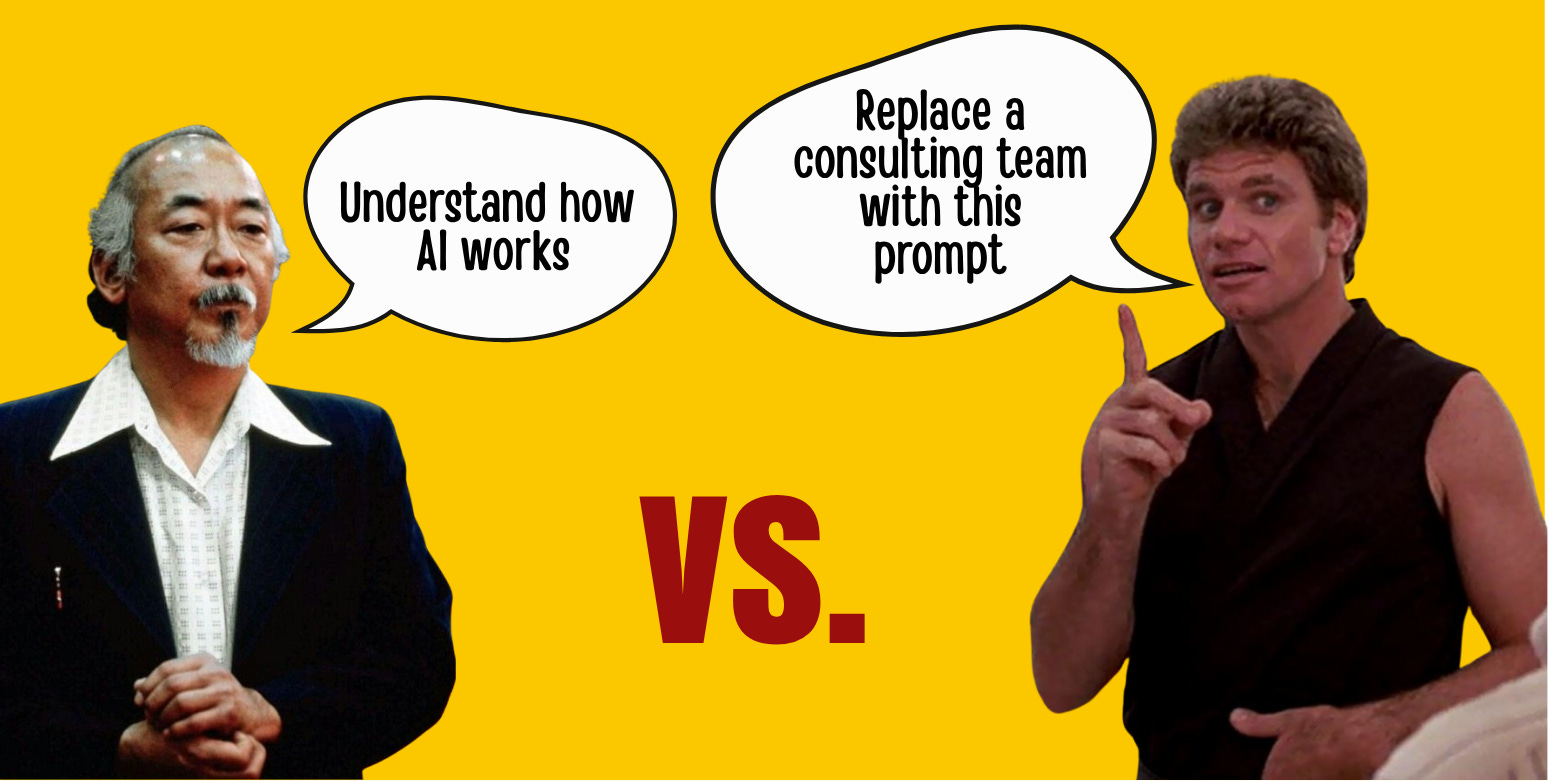
On one side, there are some voices trying to explain how this technology actually works. They talk about LLMs, agents, context windows, tokenization, and all that good stuff... you could say it’s a somewhat technical perspective.
On the other side, there are voices dedicated to giving specific (and often magical) solutions to some type of problem using AI. This is where all the variations of “use this prompt to [insert complex problem] and forget about [insert user’s pain]“ come in.
Cobra Kai
Here you learn almost exclusively to attack (no mercy), they teach you techniques that work from the moment you step into the dojo. After a short time, you feel like you can take on anyone — you already have an arsenal of techniques under your belt.
In the AI world, this looks like:
“Use this prompt and replace your accountant”
“The only technique you need to know”
“Copy and paste this prompt and save 15 hours a week”
You have the exact formula, you use it and (sometimes) it works. You feel like a champion and start sharing your “secret prompts” on LinkedIn, you’re almost convinced you’ve mastered AI... until you run into the crane technique a case that doesn’t fit the formula and you have no idea how to adjust the prompt.
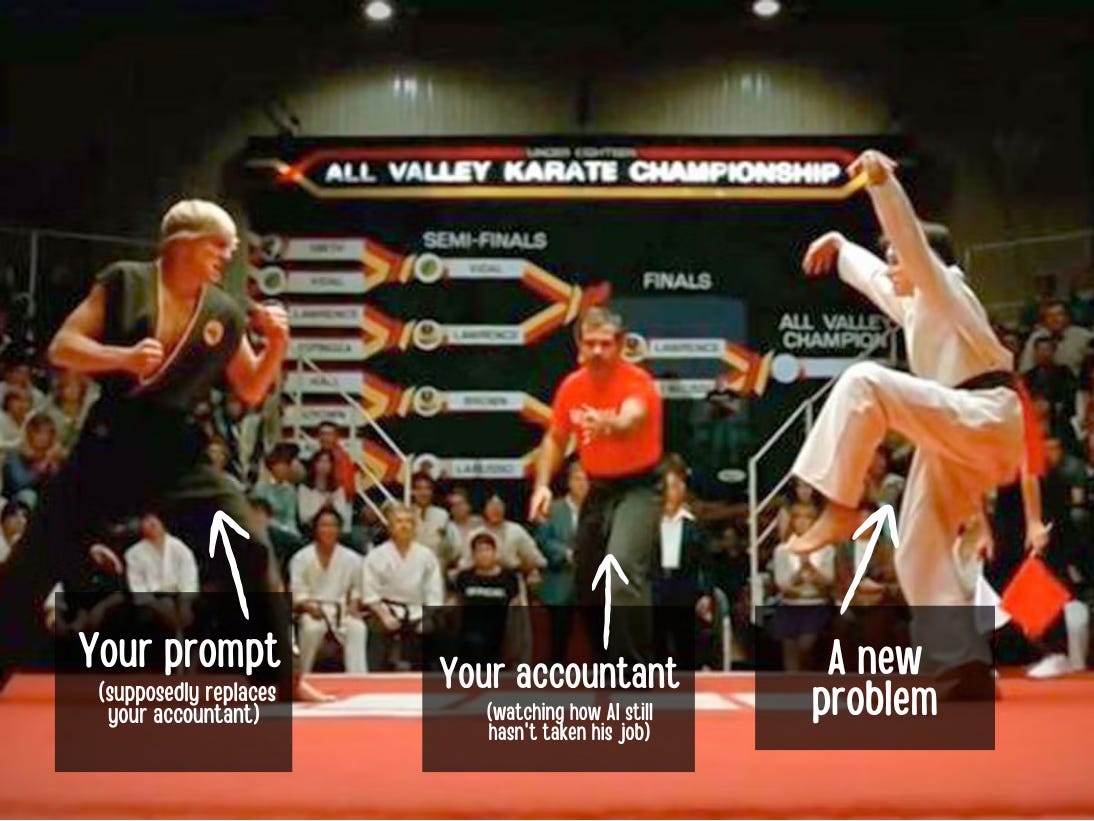
But you don't worry too much, because you can always find the next magic prompt, and the truth is that most of them work pretty well (although none of them can replace a team, no matter what Sam Altman says).
Miyagi-Do
In this dojo they teach you to understand the concepts behind the technology and encourage you to experiment, but the reality is that you came here to learn how to fight use AI, not to get a PhD in data science.
It goes something like this:
You’ve spent the entire afternoon trying to get ChatGPT or Claude to understand what you need, you’ve tweaked the prompt seventeen times. You finally got what you wanted, and even though you’re not 100% sure why, you learned something about how to structure context. Next time will be easier (or at least that’s what they tell you).
It can be frustrating, and sometimes you feel like you’re wasting your time.
It’s like someone promising to teach you karate and immediately putting you to wax and buff their four classic cars in a very specific way, without explaining why.
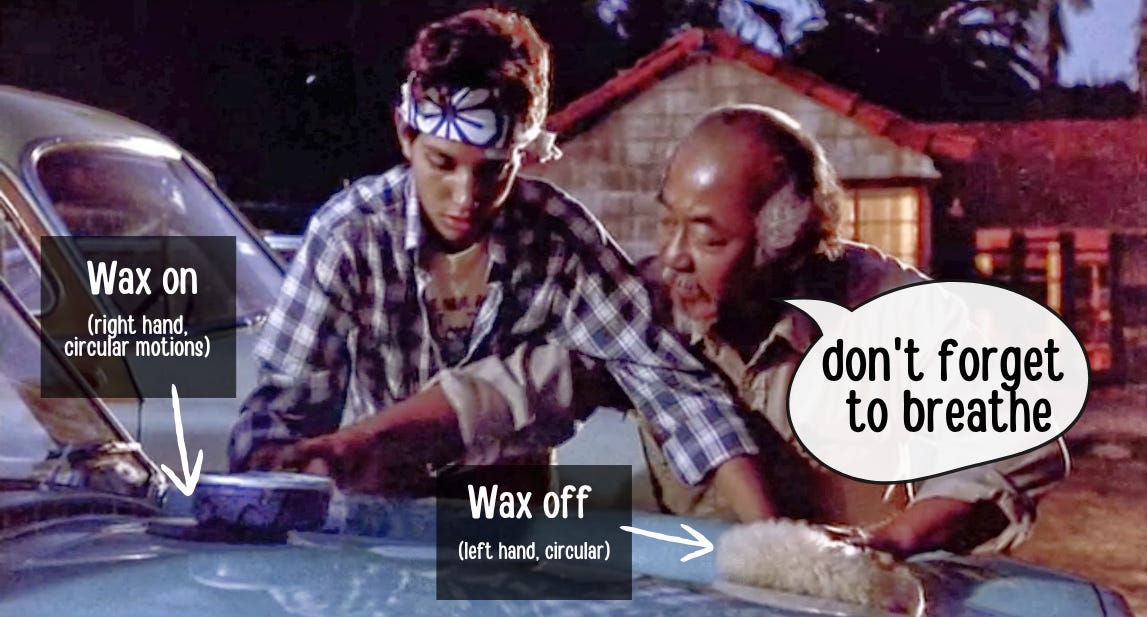
It's not something you can apply right away, it's not sexy, you can't go brag on LinkedIn about how great you are at... waxing cars?... But after a good while (if you didn't give up along the way) you no longer need to search for the perfect prompt on the Internet — you can build it yourself.
What’s at stake
In Karate Kid, what’s at stake is honor, life, and the trophy at the All Valley Under 18 Karate Championship. Here we have something at stake that’s a bit less dramatic:
The mindset with which we’re approaching AI.
Let’s go back for a minute to Karate Kid III. This is where Terry Silver shows up (one of the best villains of the series) and his Quicksilver method, an intensive training system with just three rules.
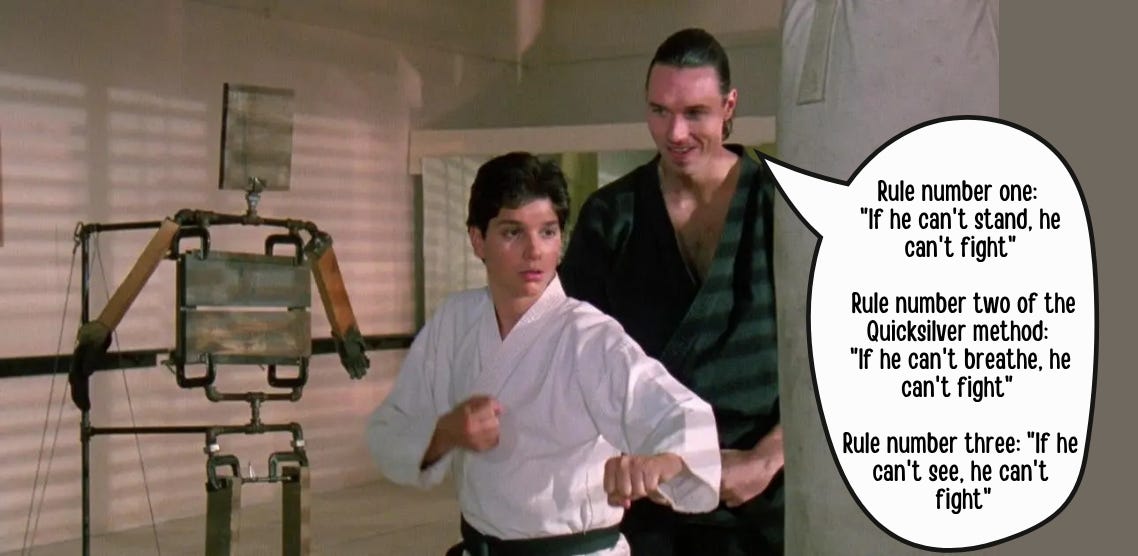
That’s right, just three rules (although they’re not exactly “sportsmanlike”), this method is effective and delivers results fast. Terry wants you to attack without thinking... and doing things without thinking is generally a problem.
Something similar happens when we start copying and pasting prompts left and right. I have no doubt that those prompts work and that they solve the problem right in front of us, but I believe using them without understanding how (and why) they work limits us enormously — how do you think things turned out for Terry Silver in the movie?
I don’t think using these prompts is terrible, what worries me is only using those prompts. Relying on a single technique to solve every problem is something that simply doesn’t work...
hmmmm... could there be an example of that in Karate Kid?
Of course there is!
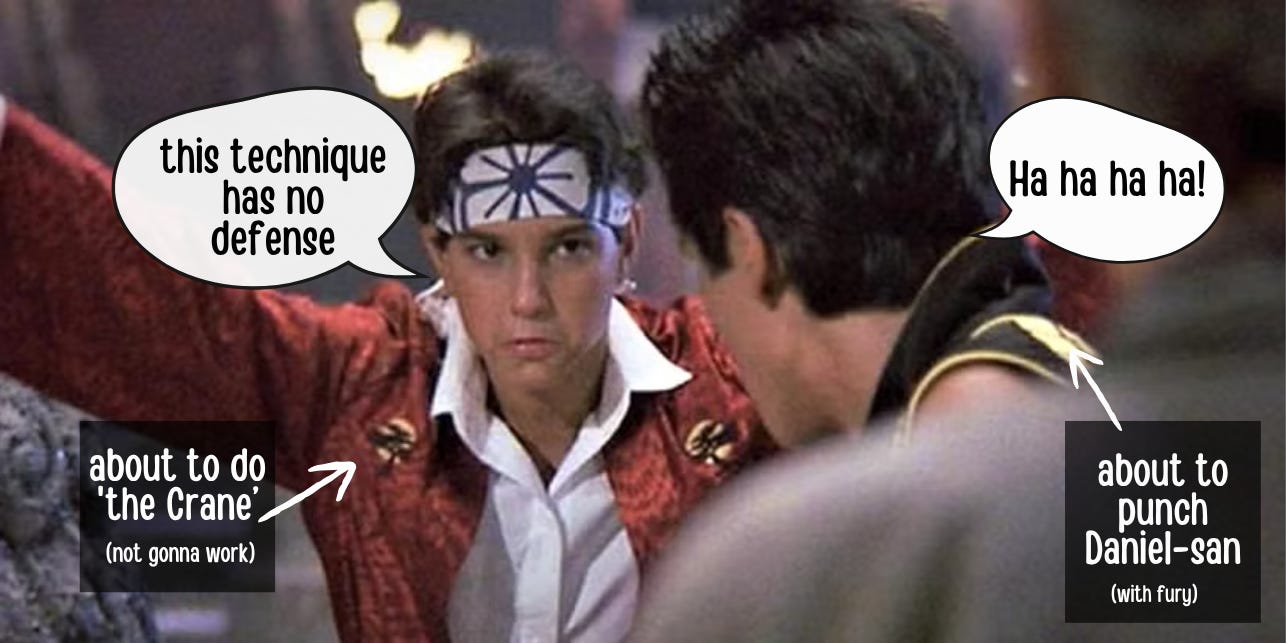
Enter Karate Kid II, where Daniel faces problems he hadn’t encountered before and innocently tries to use the crane technique against Chozen... guess what happened? It didn’t work and he almost got his teeth knocked out.
What I’m trying to say is that the prompts you find out there work. But what happens when we run into a problem that doesn’t have a “prompt to copy and paste”? What about when you want to adapt AI to the way you work? Or when some new capability drops (and in the AI world, that happens every 10 minutes)?
Well, you’d have to wait for someone else to develop a prompt so you can copy/paste it. Unacceptable (just like cheating at the 1984 All Valley Under 18 Karate Tournament).

This technology is redefining how we work, how we create, and I’d even say it’s redefining how we think.
We need to understand how it works, and I’m not talking about becoming AI experts, but about understanding at least a little bit of what goes on behind the scenes when we interact with AI.
Finding balance
Reality is always more complex than a movie, so this isn’t about choosing between Cobra Kai and Miyagi-Do, but about knowing how to combine both.
Using specific prompts, formulas, and techniques you find on the Internet is perfectly fine — it’s actually very useful. If someone already figured out how to solve something, why not take advantage of it?
The problem is not using other people’s techniques. The problem is ONLY using other people’s techniques.
The ideal is finding a balance between techniques that work and that you can apply almost immediately, and understanding the fundamentals so you can create solutions to your own problems.
As Mr. Miyagi said:
Balance not just for karate, but for whole life.

There’s one more thing... The Internet is packed with Cobra Kai-style content, which is very easy to find and consume. I see it every day, from LinkedIn posts to TikTok videos. The reality is that many of those prompts aren’t as wonderful as they claim to be, or worse, they don’t work at all.
I’ve lost count of how many times I’ve read some version of: “with this prompt replace a consulting team.” That doesn’t exist.
As Johnny Lawrence (now a responsible adult) would say: Bullshit.

If you’ve watched the Cobra Kai series, you’ll understand a bit more about balance. Here our beloved Johnny Lawrence, [spoiler] manages to balance his dojo’s aggressiveness with Miyagi’s philosophy. All without giving up his sleeveless black gi (badass!).[/spoiler].
It took Johnny more than 30 years to find that balance (we don’t have to wait that long).
About this newsletter
This newsletter is on Mr. Miyagi’s side.
I don’t consider myself an AI expert, I’m just someone who loves to learn. So I’m learning how this technology works and sharing it here with you (although my mom does say I’m an AI expert... and who am I to contradict her).
There’s a ton of content out there about “the best prompts for X,” and not nearly as much that tries to explain how AI actually works. I originally started doing this in Spanish with my newsletter aprendiendoIA, and almost nobody does it with Karate Kid memes and references to Peruvian food ;)

If you’ve been reading me for a while, you may have noticed that I avoid telling you when to use a specific technique or giving very specific examples. Why give you a Marketing example when I can give you one that includes pan con chicharrón (a legendary Peruvian sandwich)?
I do this for two reasons:
Because you know better than I do where you can apply AI.
Because it’s fun to talk about 80s shows, tamales, mondongo, or Karate Kid while trying to explain AI concepts.
This space isn’t called My AI Journey because I want to teach you (I’m no Miyagi), but because I want us to learn together.
To wrap up
Fun fact: I wrote the original version of this post on 11/11, which happens to be my birthday. So I gave myself permission to write something a bit more personal — I hope you enjoyed it.
I’ll also tell you that I studied karate as a kid for several years and I always wanted to have a sleeveless black gi, Cobra Kai style. Which by the way, has the coolest name for a dojo ever. Maybe it’s because I grew up in the 80s and 90s, when being the toughest kid on the block was all the rage?
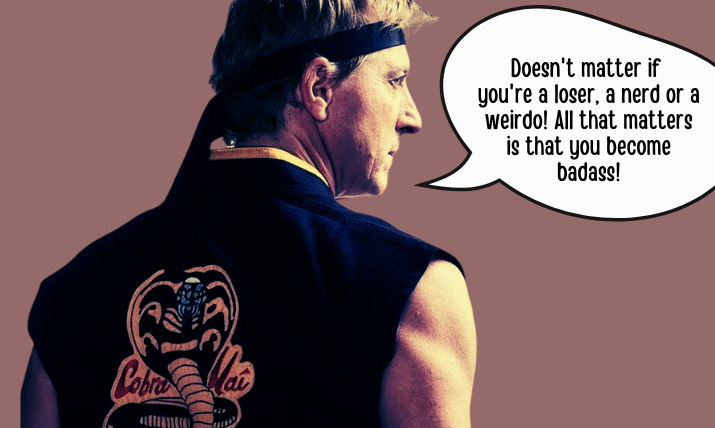
Finally, I know that learning can be scary, and sometimes it hurts to see that something isn’t working out, we can even feel defeated, but... you know what...
Fear does not exist in this dojo substack! Does it? Pain does not exist in this dojo substack! Does it? Defeat does not exist in this dojo substack! Does it?
G.